JUPITER 2025/26 SEASON

By Christopher Go

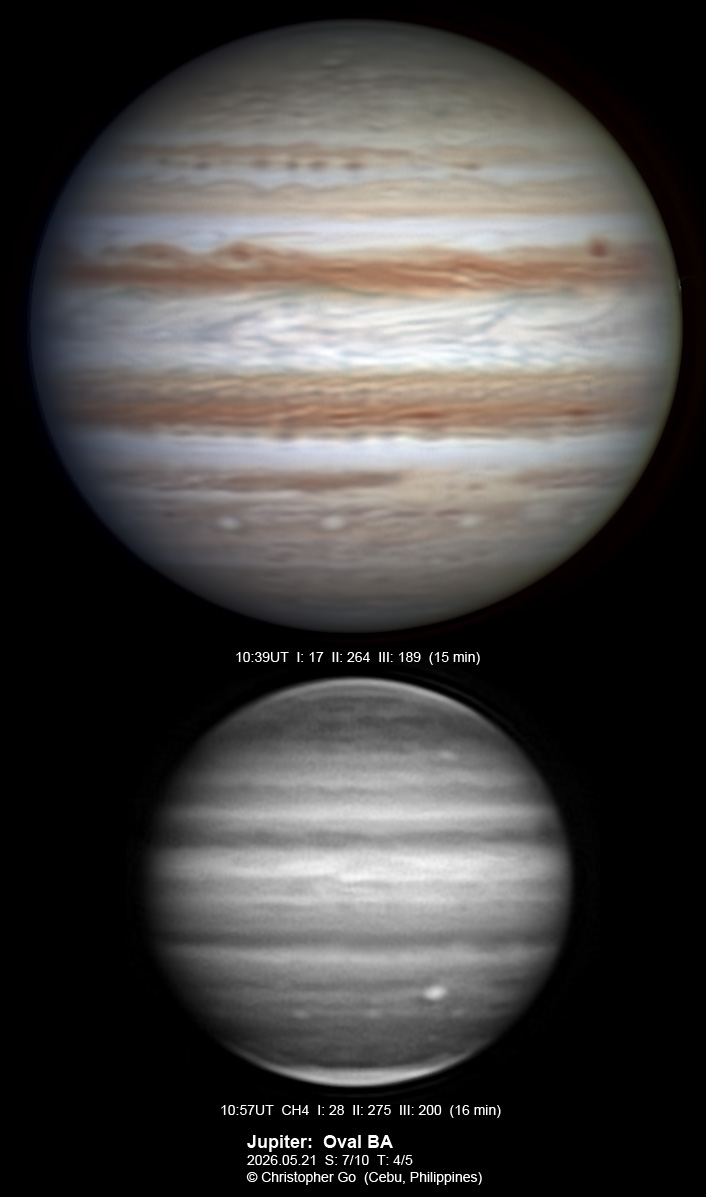
All images were taken using a Celestron C14 (with special optics) mounted on an Astrophysics AP900GTO mount.  A QHY5III585M/C (either the color and mono version) cameras were used is these images.  But most of my images are captured using the color version.  Mono-RGB is done using a set of Chroma Technology RGB filters on a Starlight Xpress Motorized filter wheel.  Methane band images are done using a Chroma Methane Band filter (889nm  18nm bandpass).  UV images are done using an Astrodon UV filter.   Amplification is done using an Astrophysics Advance Convertible Barlow working at 2.0X.  A PrimaLuce Labs Esatto robotic focuser is attached to my C14 for fine focusing.

Image acquisition was done using  Torsten Edelmann's Firecapture 2.7 64bit software.  All images are NORTH UP!     Processing was done using AutoStakkert! and Lucky Stack Worker 7.1.

These images were captured at Banilad,  Cebu City, Philippines. 

For more information on the names of various belts and zones of Jupiter and the meaning of the abbreviations I use please check the Sky and Telescope Jupiter Observing Guide.

All images of this site are my property.  If you wish to publish it on your site or print, please email me for permission.

HOME

CelestronC14!

My old images can be viewed at:
2007 Images   2008 Images   2011 Images ALPO Archives
2009 Images   2010 Images   2012 Images ALPO Japan Jupiter Section
2013 Images   2014 Images   2015 Images Jupiter with my C8
2016 Images   2018 Images   2019 Images  
2020 Images   2021 Images   2022 Images  
2023 Images   2024 Images  


March 12, 2026

Seeing was horrible today due to the effects of a Tropical Depression over the Yap Island.  I also had to deal with some clouds.

Ganymede is over the STrz.  An area on the EZn is bright in methane band.  This corresponds to the area where the festoon interact with the NEB.


March 11, 2026

The sky was finally clear today after almost a week of bad weather.  Seeing was horrible though due to the Tropical Depression over Guam.

The GRS is so tiny!  I remember when started imaging the planets over 20 years ago that the GRS was more than twice as big!  The wake of the GRS is very chaotic with a few bright outbreaks.  There is a bright outbreak on the NEBs embedded on the festoon.  The NNTZ LRS also be seen but the white spot that it consumed is gone.  The south polar red spot is also seen below.


March 6, 2026

Seeing was very unstable today.  I was only able to capture these two images before the clouds rolled in.

Nothing much happening in this region.  The STB is dark and there are several small white ovals.  The STrZ little red spot is slowly getting close to the GRS.  The NEB is quiet in this region.


March 5, 2026

Conditions were very good when I started imaging but deteriorated when I started my second luminance capture.

Io is above the SEB.  The shadow below the SEB is the shadow of Ganymede.  The second color image shows a double transit when Io's shadow joined the party.  The red Oval BA is on the left.  The NEB shows three bright spot on the color image but these spots are not bright in methane band.


March 4, 2026

I had a meeting early this evening so I was a bit late when imaging Jupiter today. I was only able to capture a set of color and methane band images before clouds rolled in. Seeing was average.

Jupiter shows the GRS and it's chaotic wake. The wake shows some outbreaks which are a little bright in methane band.  The NNTZ LRS has become very red and very bright in methane band. Probably dueof the interaction or merger of the small white spot which is gone now. The white center of the NNTZ LRS is not as distinct as before probably squished by the merger.  The large white spot (White Spot Z) is dark in methane band. Which is strange because this spot is anti-cyclone. I remember a decade ago when this spot turned light orange and was bright in methane band.

These images were captured using a Celestron C14 and a QHY5III585C camera. The color image was derotated and sharpened using LSW 7.01beta while the methane band image was sharpened using Registax and derotated using Winjupos.


March 2, 2026

I had a scare today. I had my C14 uncovered to cool it but it started to rain. I had to rush to cover it but the OTA was wet. The sky cleared briefly today to allow me to capture the image below. This is a 13X30s capture at 9/10 seeing and 4/5 transparency. Unfortunately, the sky became overcast after I captured this image. The image below was derotated and sharpened using LSW 7.01 beta.

The GRS is setting on the right. The NNTZ LRS can also be seen but the small oval that was suppose to merge with it seems to be on the left of the LRS! So apparently both spots did not merge! Note the small white spot on the NTrZn just before the CM. Europa is above the SEB before the CM.


March 1, 2026

Seeing was variable today and the skies were clear.

The STrZ little red spot can be seen in these images as it approaches the GRS in the coming months.  The NEB is active in this region and shows a lot of rifting.  Oval BA can be seen on the right edge of the first image.  The rising GRS can be seen on the left of the last image.


February 28, 2026

The sky was clear today but seeing was variable. 

The area of the SSTB preceding the white oval is very chaotic. The right edge of the STB shows the STB Ghost.  This cyclonic region is distinctly dark in methane band. The NEB is narrow in this region. 


February 27, 2026

Conditions was challenging today because of clouds.  Seeing was average but there was a lot of thin clouds.

The GRS is well resolved.  The wake is very complex and some outbreaks. As Damian Peach pointed out, the NNTZ LRS is merging with a small white spot. This is prominent in methane band and in the IR image.  In the color image, the white spot looks stretched.  The NEB is quiet in this region.


February 26, 2026

I finally had some clear skies today. Seeing was very unstable because I had winds from the mountains.


These images show the Red Oval BA. It is quite fitting because yesterday was the 20th anniversary when I discovered that Oval BA turned red. The little red spot on the STrZ is moving towards the GRS. It is interesting to see that the north polar hood has faded in methane band. We can see details close to the north pole. There are hints of the polar vortices.


The NEB shows complex rifts close the dark red cyclonic oval on the NEBn. The bright spot below this oval looks interesting but it is not bright in methane band.


February 17, 2026

Conditions were very challenging today. The sky was hazy and partly cloudy. I had to literally capture between clouds. With the low transparency I had to capture a lot of data! I only got one image set because the sky was overcast! This is a 5XRGB capture captured in a span of 10 min.

This is the region preceding the GRS.  Note the bright shark fin like feature on the SEB at the CM.  The NEB shows complex rifts.  Note the small STrZ red spot setting on the right.


February 16, 2026

Conditions were great today. 

The SEB shows the turbulence from the GRS.  The NEB has a lot of complex rifts.  There is a bright outbreak on the NEB at the CM but this isn't bright in methane band.  Note the details on there below the bright north polar hood in the methane band image.


February15, 2026

Weather during the last few days had been horrible due to the NE Monsoon.  I had a short break today but seeing was variable and I had to image through clouds.

The GRS is setting on this image.  The wake of the GRS is very chaotic and it shows an active outbreak.  The NEB is quiet in this region. 


February 7, 2026

After days of bad weather and a tropical depression today, I had a brief clearing to image Jupiter. Seeing was excellent but transparency was very poor! I could only capture RGB because of poor transparency. I had to stop when the sky became overcast.


This image was processed using LSW7deconvolution/Winjupos. I couldn't get it to derotate with LSW7.
The GRS is prominent in this image. Note the bright outbreaks on the left. Note the dark red barge on the right on the SEB. It seems to have a bright flare above it. Will this develop into a major outbreak on the SEB.
The NEB shows some rifts and a white spot on the CM. Unfortunately, I couldn't capture any methane band image due to poor transparency.


January 29, 2026

Conditions here had been challenging due to the shear line of a cold front from Siberia.  Seeing was awful and I had to image through passing clouds.

Europa is in transit above the GRS.  It's shadow following on the left.  The wake of the GRS shows a distinct white spot which might grow into an outbreak.  The NEB is narrow in this region and show some rifts.  The NNTZ LRS is also visible.


January 22, 2026

I finally had some clear skies and descent seeing after a brush with a tropical cyclone.  Seeing was still a little unstable. 

The GRS is setting on the first image.  Chimney above the GRS is close.  The wake of the GRS is chaotic but doesn't show any outbreak.  The NEB is wide in this region. The STB ghost seems to be interacting with a SSTZ white spot.  Is this interacting rebuilding the STB?  The NNTZ LRS and the south polar red spot are also prominent in these images.


January 18, 2026

I had a brief imaging run today.  I started imaging with mono camera because Jupiter was still low in the sky.  The sky became overcast as I started my color camera capture.

Io and it's shadow are transiting above the SEB.  The NEB is narrow in this region.  There are a lot of rifts in this region.  The dark red feature on the NNTZ has shrunk!


January 12, 2026

Conditions were poor today due to clouds.

The GRS is well resolved.  The "chimney" above the GRS is close while the wake shows a bright outbreak.   The NEB shows complex rifts.  The NNTZ LRS and the South Polar red spot can also be seen.


January 8, 2026

Conditions were challenging today due to clouds.  I could only capture a set of data before the sky became overcast. 

Note red barge on the NNTZ.  The shape of this feature has changed over the months.  The NEB shows complex rifts.  The SEB is quiet in this region.


January 7, 2026

It was cloudy most of today but the sky clear close to midnight.  Seeing was variable but was perfect during the middle of my session.

2 days before Jupiter Opposition!  The GRS is well resolved.  The wake of the GRS shows a complex outbreak.  The NEB is narrow in the region.  It shows some rifts but no outbreak.  The NNTZ LRS and the South Polar Red Spot can be see in these images.  In the methane band, the bright north polar hood is gone!


January 6, 2026

The conditions started unstable because I was trying to image early.  It became perfect as Jupiter got higher.

The red ring of Oval BA is resolved.  The STrZ little red spot is almost above Oval BA.  The NEB is narrow in this region.  The SEB is quiet in this region.

January 5, 2026

The last few days had been cloudy here due to a cold front from Siberia.  I finally had a clearing last night and seeing was good.

The GRS is setting on the right.  The SEB shows the wake of the GRS.  The STB shows the STB Ghost.  The NEB shows an outbreak associated with a festoon. The NEB also shows some complex rifts.  The NNTZ LRS is also prominent.


January 1, 2026

Here are my first Jupiter images of the year!  Seeing was good but transparency was a times variable due to passing thin clouds.

The red Oval BA is resolved with it's prominent red ring.   The STrZ little red spot can also be seen.  Small red spots do appear on the STrZ and will usually get destroyed when it gets to the GRS.  The NEB shows a bright outbreak. 


December 31, 2025

Happy New Year! Last night, Simon Tang and I completed recording the first part of my updated Planetary Imaging video tutorial.  These image were captured during that session.  Seeing was excellent at times but due to fireworks, conditions would sometimes deteriorate.

The GRS is well resolved.  The wake of the GRS shows two bright outbreaks.  The NEB shows complex rifts.  The NNTZ LRS shows a strong red color.  The South Polar red spot can also be seen on the lower left of the last color image.


December 29, 2025

I started imaging early today with Jupiter barely 50deg.  I used a QHY5III585M mono camera for this.  Seeing was excellent but there were periods of thin clouds passing by.

The SEB shows the wake of the GRS.  The NEB is active in this region with complex rifts and a bright outbreak.  The STB STB ghost is prominent on the left.  This feature is very dark in methane band.  The NNTZ LRS can also me seen or the right.  There is a red oval (probably cyclonic) at the CM of the NNTZ on the 2nd image.


December 26, 2025

Simon Tang and I were working on a Planetary Imaging tutorial video when I captured this image. The sky was clear with perfect seeing when we started but it suddenly became overcast!  I had to image between clouds.  This is a 3 RGB set capture with a QHY5III585M (mono) camera.  Each set was around 10 minutes apart. I did not know how Winjupos would be handle this but it came out very well.

The GRS is prominent in this image.  The "chimney" above the GRS seem to be closing.  The wake of the GRS is complex but with no outbreak.  The NEB is narrow and shows a complex rift.  The NNTZ LRS can be seen on the upper left.


December 24, 2025

Merry Christmas!  I had a clearing today and conditions were excellent.

Callisto's shadow is in transit.  It is interesting to see that it's shadow has a penumbra!  There is a bright outbreak in the NEBs at the CM of the first image.  There are small red ovals on the NTBn.  The STB shows the STB Ghost. The south polar red spot can be seen on the first image.


December 22, 2025

The last few days had been very cloudy here.  I finally had some clearing but the sky was hazy and we had some thin clouds.  Fortunately seeing was excellent.  I used a mono (QHY5III585M) on the first image and a OSC (QHY5III585C) for the second.  I had to capture a lot of data to compensate the low and variable transparency.

Note the bright outbreak and rifts on the NEB.  This outbreak seem to be interacting with the dark red barge.  There is a large reddish barge on the NTB. The SEB is quiet in this region.  The STB Ghost can be seen on the after the CM of the first image.


December 16, 2025

Conditions this morning was crazy. Half the sky was overcast (with rain) while the other half was clear. The sky was clearing so I went ahead and took some images. Seeing was around 8/10. Unfortunately after taking a set of luminance and IR pass images, the sky became overcast.


The GRS is is well resolved in this. The wake of the GRS has a bright outbreak. The chimney above the GRS is still open. Details on Ganymede can also be seen. Note the bright outbreak like features on the NEBs. The NNTZ LRS is also very distinct.


December 14, 2025

Conditions were poor today. Seeing was unstable and transparency was poor due to haze and thin clouds.

The GRS is rising on the left and Oval BA is setting on the right.  Note the large white cloud on the SSTB which is bright in methane band.  The "chimney" above the GRS is WIDE OPEN!  The SEB shows the dark red oval interacting with the material from the chimney.  The NEB is narrow this season.


December 9, 2025

I imaged around midnight tonight to capture the GRS and Ganymede.  Conditions were perfect!

Details inside the GRS are well resolved. In the methane  band image, a dark ring can be seen inside the GRS.  There is a bright outbreak on the wake of the GRS.  The "chimney" above the GRS is open. The NEB is narrow in this region.  The NNTZ LRS is also very prominent.  Ganymede is also well resolved with surface details.


December 7, 2025

TD Wilma brought cloudy skies the last few day.  It finally cleared today and seeing was perfect.

Note the bright outbreaks on the NEBs.  On the STB, the STB Ghost can be seen as the bluish feature there.  On the NNTZ just after the CM on can see some red spots that seem to be merging.


December 3, 2025

A potential tropical cyclone is about to interact with the cold front which will send more rains to our region in the coming days. I had a clearing his evening but seeing was a bit unstable and it was very windy.

The red ring of Oval BA is resolved.  The red spot on the STrZ is definitely anti-cyclone.  It is bright in methane band.  Europa and it's shadow is currently transiting the SEB.  There is a complex rift on the NEBs on the right.


November 29, 2025

Conditions were perfect when I started imaging.  But it deteriorated as clouds started rolling in.

The GRS is well resolved in this image.  Details inside the GRS can be seen.  There is a bright outbreak at the wake of the GRS.  The chimney above the GRS is open. The NEB is quiet in this region.  It is also very narrow.  The NNTZ LRS can be seen on the upper left.

November 28, 2025

Seeing was average today and transparency was poor due to haze.

Oval BA shows it's distinct orange ring.  We can basically say that Oval BA is red again!  Note the little red spot on the STrZ.  It looks like a little GRS.  This feature looks anti-cyclonic as it is bright methane band.  The NEB is showing some bright outbreaks but these are not bright in methane band.


November 17, 2025

I had to image early today to catch the GRS.  Jupiter was still a bit low in the sky when I captured the first image.  Seeing then was just average.  Seeing improved when Jupiter got higher.

The GRS is well resolved.  As Shinji pointed out, the "chimney" above the GRS is open!  There is a bright outbreak on the wake of the GRS.  The NEB is quiet in this region.  The NNTZ LRS can be seen on the upper left.


November 16, 2025

Conditions were challenging today because of thin clouds.  I had to capture a lot of images to compensate the poor transparency.

Oval BA is prominent on this image. It has a strong orange color. Note the Bright spot on the SSTB preceding Oval BA. Too bad I wasn't able to capture a methane band image to check if this is an outbreak. Note the bright spot rising on the NEBs on the left. It seems to be interacting with a dark EZ festoon.


November 6, 2025

The last few days had been quite eventful. We took a hit from Typhoon Kalmaegi.   Although the winds were not as devastating as Super Typhoon Rai, the flash floods devastated our area.  My family is fine.  I was finally able to resume imaging this morning.  Seeing wasn't that great because a new typhoon (Fungwong) is  headed towards our region.  However, this cyclone won't hit us as it is headed for Luzon.

Oval BA now has a light orange ring. This spot had turned back white 6 years ago and it's "red" ring would often appear.  Note the complex rift on the NEB.  The NEB is quiet in this region.   What is strange is the white anti-cyclonic white spot on the SSTB isn't bright in methane band.  There seems to be a reddish cyclone to it's left.


October 31, 2025

I finally had perfect conditions this morning!  The sky was CLEAR. I haven't had this in ages and we had a good laminar flow!

The details on these images are incredible.  Note the two bright spots on the NEBs. These spots are, however, not methane right so I don't think there are outbreaks.  The GRS is setting on the right.  It's just incredible to see how tiny it has become.  The wake of the GRS is very chaotic.  Note the dark red barges following the wake of the GRS.  The NNTZ little red spot can also be seen.  This anti-cyclone is bright in IR and CH4 band.


October 29, 2025

Conditions had been challenging during the past week with clouds and rain.  Seeing was excellent this morning but I had to deal with clouds.  My run was cut short when the sky became overcast.

The SEB and NEB looks quiet in this region with no outbreaks.  The STB seems to be disrupted  by two cyclonic features.  This might the STB Ghost.  The South Polar red spot can be seen on the bottom right.


October 22, 2025

It was very windy this morning.  Seeing was unstable because of the shaking but transparency was very good.

There is a feature on the NTrZ around the area of the CM.  This feature is bright in IR and a little bright in methane band.  The NEB and SEB looks quiet in this region. There seems to be two cyclone features on the STB disrupting the band.  There is also a large oval on the south polar region .


October 21, 2025

I was finally able to image Jupiter today.   Seeing was good but transparency was poor due to clouds.

The GRS can be seen in these image.The GRS is very small!  Note the small while oval above the GRS on the dark halo. The area of the STB below the GRS looks chaotic with dark ovals clearing the STB.  The NEB is quiet in this region.


Copyright 2023 Christopher Go (chris@cstoneind.com)